
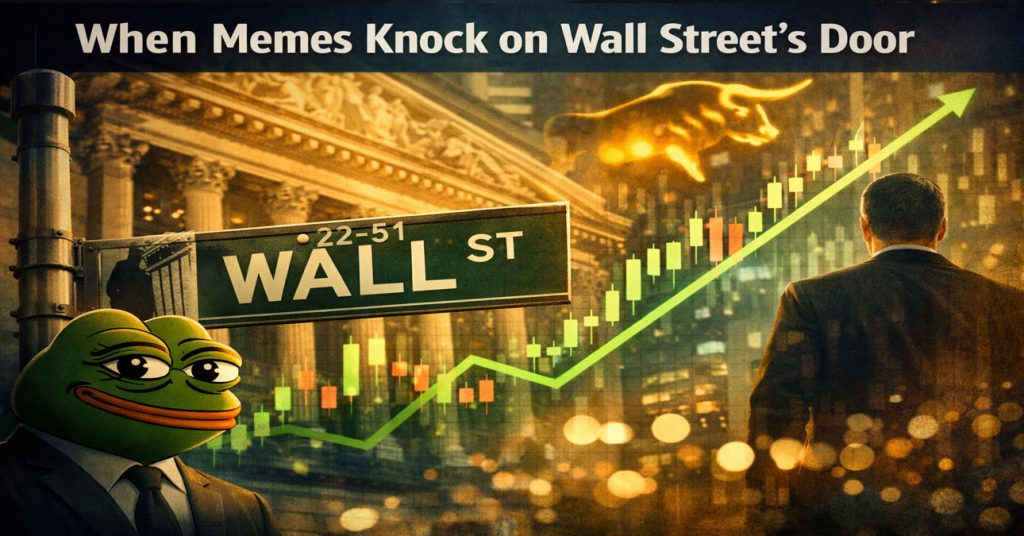
There was a time not long ago when meme assets were treated as noise—fleeting bursts of speculative energy with no structural relevance to markets that mattered. They were cultural artifacts, not financial instruments. That distinction is now beginning to blur.
The emergence of institutional conversations around assets like PEPE signals something more than opportunistic speculation. It suggests that the market is undergoing a subtle recalibration—one where attention, narrative, and liquidity are no longer separate forces, but increasingly intertwined components of valuation.
What was once dismissed is now being studied.
The Repricing of Attention
Markets have always priced information. What is changing is the type of information being considered valuable.
In traditional finance, value is derived from cash flows, balance sheets, and macroeconomic positioning. In crypto, a parallel framework has quietly developed—one where attention itself becomes a measurable and tradable input.
Memes, by their nature, aggregate attention at scale. They move faster than traditional narratives, spread wider than institutional research, and often capture retail sentiment before it is visible through conventional indicators. For years, this dynamic existed outside the institutional lens.
Now it is being pulled in.
The possibility of a PEPE-linked financial product is not about legitimizing a meme. It is about recognizing that the mechanisms driving participation—liquidity flows, coordinated attention, and rapid narrative formation—are too significant to ignore.
From Dismissal to Integration
Institutions do not move toward volatility without a reason. When they engage, it is typically because a pattern has become persistent enough to model.
Memes have demonstrated:
- Repeatable cycles of capital formation
- High-speed liquidity concentration
- Global participation without traditional barriers
These are not anomalies. They are signals.
What changes at the institutional level is not belief—it is strategy. The question shifts from “Is this real?” to “How do we position around it?”
This is where the conversation moves beyond speculation.
A recent breakdown by CoinEpigraph explores how a potential PEPE ETF signals something deeper than market enthusiasm—it reflects an early-stage attempt to structure and contain a form of value creation that was previously considered uncontainable.
The Structural Question
If attention can be priced, and if memes are among the most efficient vehicles for capturing that attention, then the implications extend far beyond a single asset.
It raises a more complex question:
Are markets evolving to reflect fundamentals more accurately—or are they expanding to include entirely new definitions of what a “fundamental” is?
The answer may not be binary.
What is becoming clear is that the boundary between culture and capital is weakening. And as that boundary dissolves, assets once viewed as peripheral begin to move closer to the center of financial consideration.

The Moment Before Definition
We are not yet at a point of full integration. There is still skepticism, still resistance, still a reluctance to formalize what feels inherently informal.
But that is often where structural shifts begin—not with consensus, but with tension.
Memes entering institutional frameworks do not resolve that tension. They amplify it.
And in that amplification, markets are forced to confront a new reality:
Value is no longer defined solely by what can be measured traditionally—but increasingly by what can be sustained collectively.
© 2026 CryptoEthos™ provides information and entertainment. CryptoEthos.com does not provide investment advice. Do your research before taking a market position on the purchase of cryptocurrency and other asset classes. Past performance of any asset is not indicative of future results. All rights reserved.